An ordering app built around the regulars
Phone and WhatsApp orders work until the lunch rush, when the wrong salsa goes out and the line rings unanswered. This demo shows the customer side of an ordering app a taquería could run itself — and is honest about when a simpler tool would do.
The problem
A busy taquería takes orders three ways at once: the counter, the phone, and a WhatsApp chat someone checks between tickets. Each one loses detail. “Two birria, one with no onion” becomes three tacos with onion, the customer calls back to ask if it is ready, and the delivery platforms that fix the chaos take a commission on every order — including from regulars who would have ordered anyway.
The approach
Make the order complete before it reaches the kitchen
The flow is built so the kitchen never has to guess. Each item asks for the choices that cause the most mistakes — the protein is marked required, salsas show their heat level — before it goes in the cart. The confirmation screen gives the customer an order number and an estimated ready time, which answers the “is it ready yet?” call before it is made.
What’s in the build
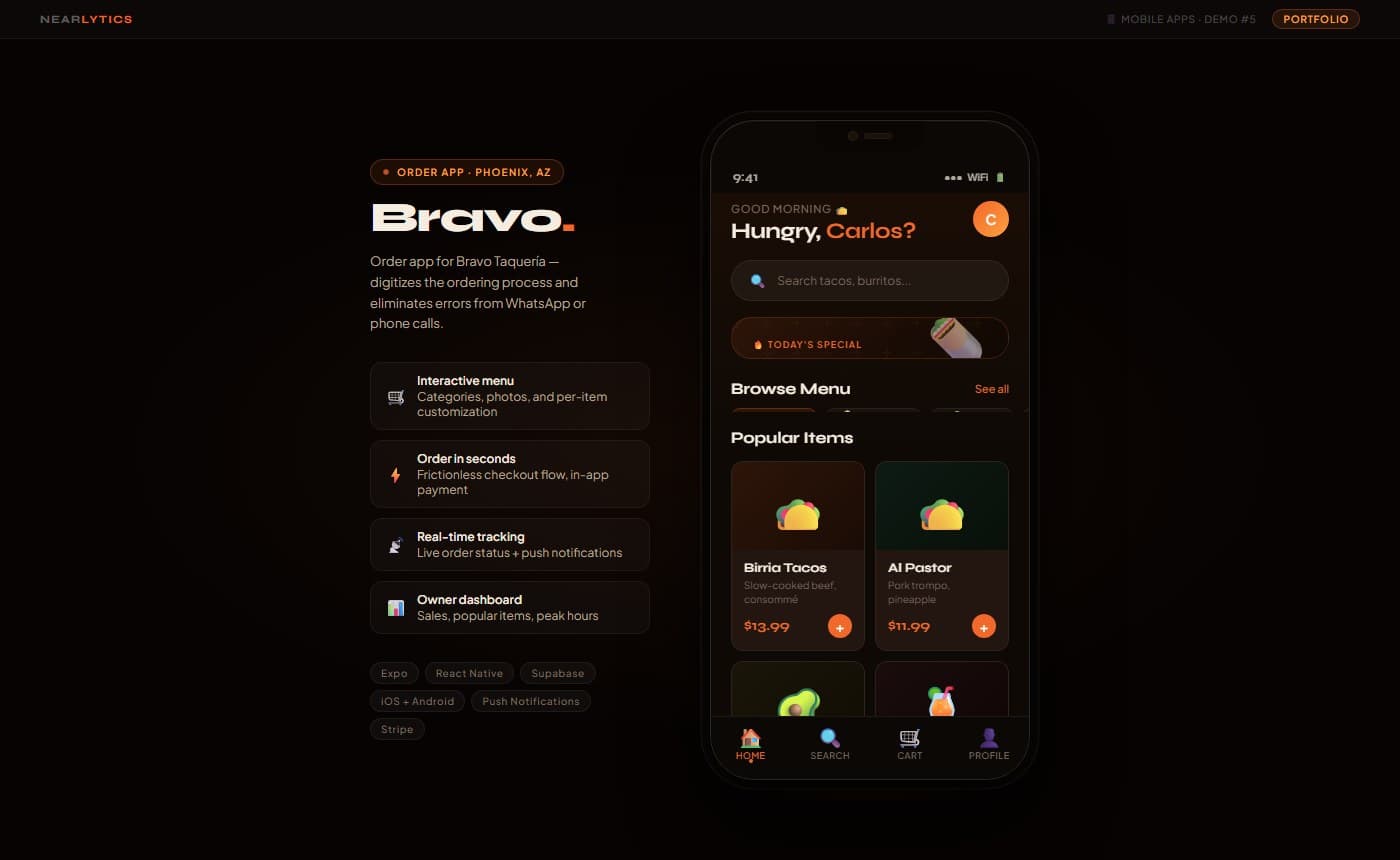
- A home screen that opens on the regular’s usual: one button with everything they picked last time, two taps from opening the app to a placed order
- Menu items that ask for the choices that cause mistakes: tortilla, salsa marked by heat, and “no onion” as a button instead of a note
- A pick-three taco order that will not go in the cart until exactly three proteins are chosen
- A cart with tax and a ready time worked out from Phoenix time, the lunch rush and the size of the order; after hours it schedules for opening
- A confirmation with an order number and the ticket exactly as the kitchen receives it
- A commission calculator comparing what a regular’s order leaves the restaurant on a marketplace and in its own app
Who this fits
- Restaurants with a base of regulars who order every week
- Taquerías, cafés and food trucks taking orders by phone or WhatsApp
- Owners paying delivery-platform commissions on customers they already have
Decisions worth explaining
Required choices, not free-text notes
A notes field is where orders go wrong. Turning the common decisions — protein, salsa, quantity — into explicit choices means the ticket that reaches the kitchen is complete and readable, every time.
The confirmation answers the next phone call
Most calls after an order are one question: is it ready? An order number and an estimated ready time on the confirmation screen answer it up front, which means fewer interruptions at the counter during the rush.
What a production build adds
The demo is a clickable prototype of the customer flow. A real build connects it to payments, sends the order to the kitchen, notifies the customer when it is ready, and gives the owner a view of sales and peak hours. Those pieces are scoped per restaurant, which is why they are not faked here.
About this demo
Bravo Taquería is a fictional restaurant built to demonstrate the approach. The demo is a clickable prototype of the customer side — menu, cart and confirmation work; payments, kitchen routing and notifications are what a real build adds.
Questions
Does a restaurant need an app, or is online ordering on a website enough?
For many restaurants, an ordering page on the website is enough and costs far less. An app earns its price when a meaningful share of customers order every week: it lives on their phone, remembers their usual order, and can notify them about a special. If most of your orders come from one-time visitors, start with the website.
What does a restaurant ordering app cost?
Our mobile app work runs $4,000–$15,000, delivered in 4–8 weeks, for iOS and Android from a single codebase. A focused ordering app for one location sits toward the lower end; loyalty programs, multiple locations and deep POS integration move it up.
Can it replace DoorDash or Uber Eats?
For your regulars, it can — those are the customers you pay a commission on even though they already know you. For discovery, no: delivery platforms bring new customers that an app of your own will not. Most restaurants keep both and steer repeat customers to the app.
Let’s start
Let’s talk about
your business.
20-minute discovery call. No pitch, no pressure — just a conversation about what your business actually needs and whether we’re the right fit.