The Monday 7 AM report that writes itself
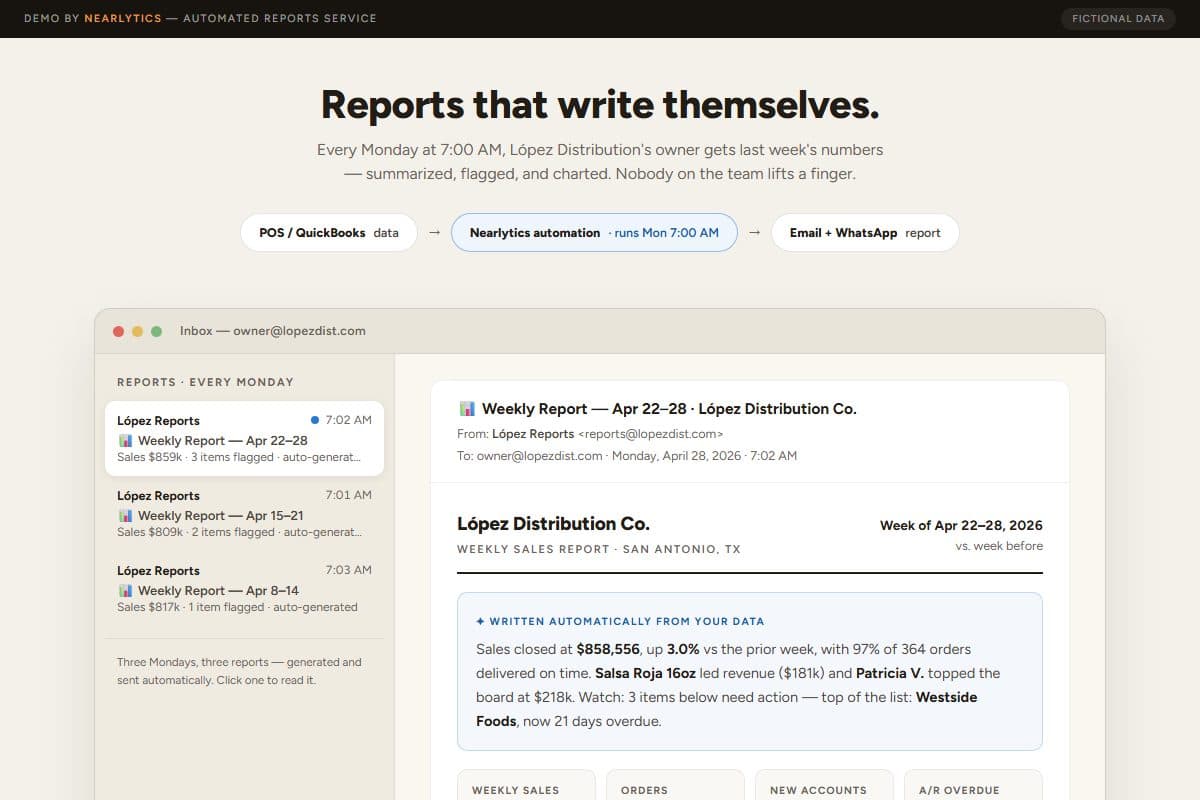
A weekly report is usually somebody’s Monday morning. This build hands that morning back: the numbers are gathered, the summary is written, and the exceptions are flagged before anyone sits down.
The problem
In most small distributors one person rebuilds the same report every week — export, paste, re-format, re-check the formulas, write a summary nobody asked for. It takes half a day, it is the most interruptible task in the business, and the moment that person is on holiday it simply does not happen.
The approach
Report by exception, not by dump
The default failure of automated reporting is sending everything and calling it thorough. This one leads with a written summary in plain language, then shows only what broke the pattern — an account that stopped ordering, a margin that slipped, a delivery window that keeps being missed. The full tables are still there, underneath, for whoever wants them.
What’s in the build
- A written weekly summary in plain language, not a wall of tables
- Exception alerts: accounts that went quiet, margins that moved, deliveries that slipped
- Week selector, so any prior week can be re-opened exactly as it was sent
- Delivered to the inbox on a schedule — no login, no dashboard to remember to check
- The same content readable on a phone, because that is where a Monday 7 AM email gets opened
Who this fits
- Distributors and wholesalers tracking accounts, margin and delivery performance
- Any business where one person manually rebuilds the same report weekly
- Owners who want to be told what changed, not handed a spreadsheet
Decisions worth explaining
Email, not a dashboard
A dashboard requires someone to remember to open it. A report arrives whether or not anyone remembers. For a weekly rhythm the inbox wins, and the dashboard becomes the place you go only when the email raises something.
The summary is the product
The tables are the easy part. The value is the paragraph at the top that says what happened and what deserves attention — which is exactly the part a person used to spend half a day writing.
About this demo
López Distribution Co. is a fictional distributor built to demonstrate the approach. The figures are generated — the report format, the exception logic and the interaction are real.
Questions
Where does the data come from?
Wherever it already lives — an ERP, an accounting system, a Google Sheet, or a nightly CSV export. The report is built on top of whatever export your systems can already produce, so nothing has to be replaced to get started.
What does an automated report cost?
Our automated reporting work runs $500–$2,500 depending on how many systems have to be joined and how much logic sits behind the alerts. A single-source weekly report is at the lower end.
What happens when the numbers look wrong?
The report shows its working — every figure can be traced back to the source rows that produced it. Automated reporting is only useful if it is trusted, and it is only trusted if it can be checked.
Let’s start
Let’s talk about
your business.
20-minute discovery call. No pitch, no pressure — just a conversation about what your business actually needs and whether we’re the right fit.