A tire shop site that shows the wait before you drive over
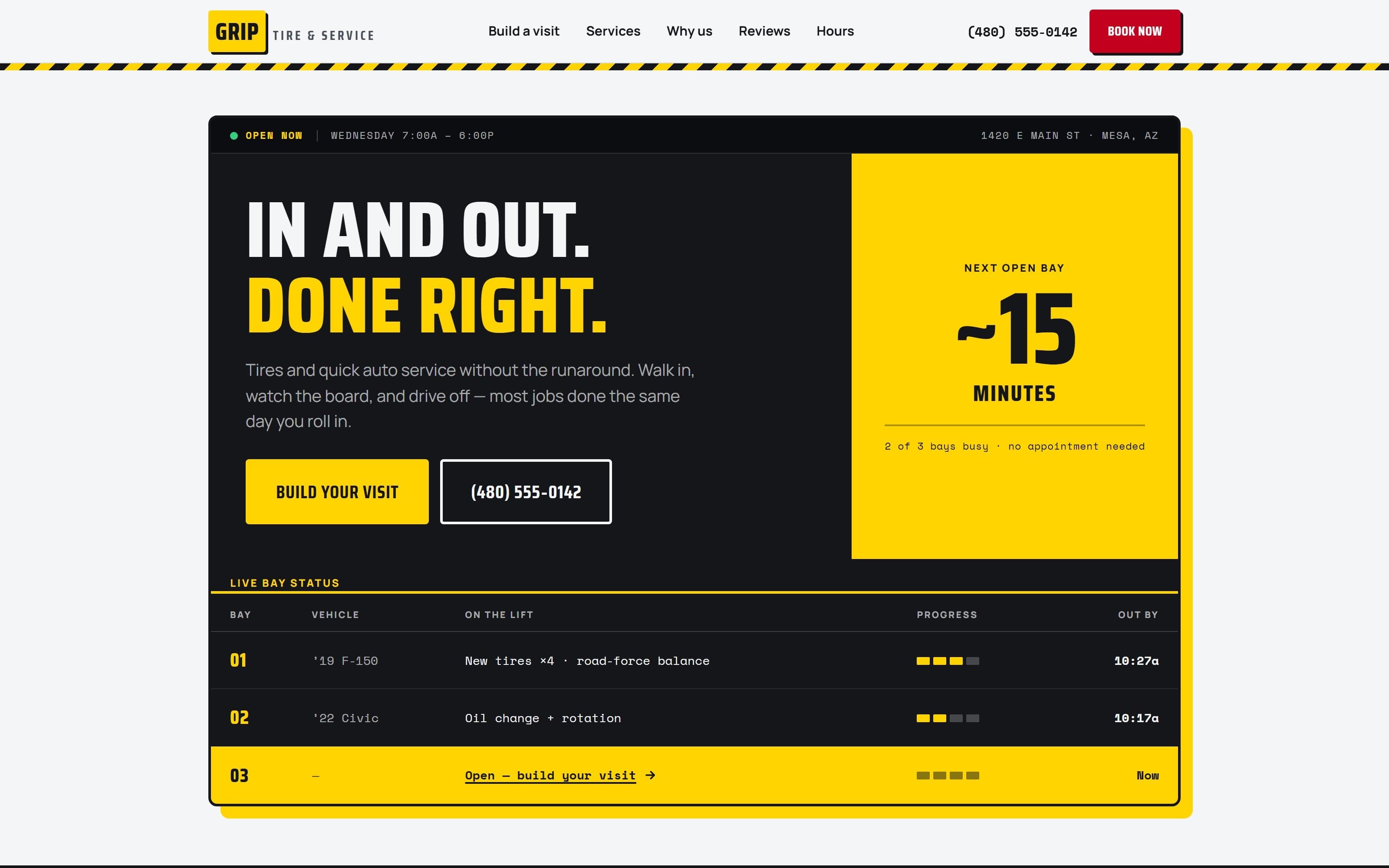
Every auto shop site says “fast service”. This one shows it: the first screen is a bay board with the next open slot, and a diagram of a car turns what you need into a price range and a time before you ever call.
The problem
Someone with a nail in a tire or an oil-change light on has two questions, and neither is about the shop’s history: how much, and how long am I going to be stuck there? Most shop sites answer with a phone number and “call for a quote”, so the driver calls three shops — or goes to whichever one they can see from the road.
The approach
Open on the board, not a photo
The first viewport is a bay-status board — a real table of bays, what is on the lift, progress and out-by times — with the free bay as the main call to action. Its open or closed state and its times are computed from the visitor’s own clock against the shop’s real hours, so on a Sunday it says when the shop opens instead of showing a wait that does not exist. Below it, tapping parts of a car builds a visit: each service adds its price range and its time, and the ticket says roughly when you will be back on the road.
What’s in the build
- A live bay-status board as the hero, built as a real table so it works with a screen reader, with the free bay as the call to action
- Open/closed state and out-by times computed from the visitor’s clock against real hours — Mon–Fri 7–6, Sat 8–4, closed Sunday
- A tap-the-car visit builder: six services, each adding its price range and its time to a running ticket
- A service menu with prices and typical times, and a price-match promise stated in plain words
- AutoRepair and FAQPage structured data, with hours and service area for local search
Who this fits
- Tire, quick-lube and general repair shops that take walk-ins
- Shops whose phone rings all day with “how long?” and “how much?”
- Independent shops competing with dealership service departments on price and speed
Decisions worth explaining
An honest closed state
A board that says “~15 minutes” at 9 PM on a Sunday is a lie the visitor can catch. When the shop is closed the board says so and shows the next opening. A tool like this only earns trust if it is right when the answer is inconvenient.
Ranges, and a free look
The builder shows a range, not a single price, and says the final price is confirmed after a free look at the car. That is the truth of auto repair — and a range up front still beats “call for a quote”, which is where most drivers give up.
Bright, not blue-and-red
Auto shops default to dark blue, red and chrome. This build is pale slate, asphalt and signal yellow with a hazard-stripe motif — closer to the bright quick-lube chains drivers already associate with speed than to a dealership service desk.
About this demo
Grip Tire & Service is a fictional shop built to demonstrate the approach. The owner, reviews, ratings, prices and bay activity are invented. The board’s clock logic, the visit builder and the accessibility work are real and interactive; nothing you choose is sent anywhere.
Questions
What does a website like this cost for an auto shop?
Our landing-page work runs $800–$2,500 and goes live in 2–3 weeks. A straightforward single page with hours and a booking form sits at the lower end; interactive tools like the bay board and the visit builder move it toward the upper end.
Can the bay board show real data from our shop?
Often, yes — if your shop-management software can share job status, the board can read it. If it cannot, the simpler version shows your hours, the next opening and a wait your front desk updates. Which one is possible gets checked before we quote, not after.
Should an auto shop publish its prices?
Ranges, yes. Drivers know the final number depends on the car, and they do not expect a fixed quote online. What they want is to know whether a brake job is a $200 problem or an $800 one before they take time off work — and the shop that tells them gets the visit.
Let’s start
Let’s talk about
your business.
20-minute discovery call. No pitch, no pressure — just a conversation about what your business actually needs and whether we’re the right fit.